Leadership & People Management
Jordan Park’s proposed leadership system connects clear roles, staff development and measurable accountability. This is an academic model for a fictional community racquet sports facility.
Organizational Management
Defined reporting relationships, weekly staff meetings, role expectations and RecTrac records support dependable daily service.
Coach Development Pathway
Recruit → Onboard → Observe → Coach → Develop → Retain
Four weeks of orientation, shadowing and supervised delivery lead to a 90-day review, annual goals and continuing education.
People, Safety & Accountability
The toolkit below brings together the staff handbook, operating procedures, Safe Play guidance, risk responses and performance targets. Recognition, regular feedback and clear follow-up support a consistent experience for staff and participants.
Leadership master portfolio (PDF): the complete project covering organizational management, staff development and operating systems.
Operating Toolkit
Core 3 resources for staff development, day-to-day operations, safety, and accountability.
Performance Targets
Proposed operating goals for Jordan Park, not reported results.
How performance will be measured
Proposed measurement protocol. Establish a baseline in the pilot; targets below are goals, not achieved results. Use unique participant IDs and consistent cohort dates so repeat registrations are not double-counted.
| Measure / target | Calculation and source | Review / proposed owner |
|---|---|---|
| Customer retention ≥70% | Participants in one completed session who register for the next eligible session ÷ participants in that original cohort ×100. RecTrac registration records; report cohort dates and exclusions. | Each session / program lead. Review placement, scheduling and follow-up if below target. |
| Coach retention ≥85% | Coaches employed at the start of a 12-month period who remain at its end ÷ coaches employed at the start ×100. Staff roster; explain seasonal contracts and departures separately. | Quarterly trend; annual result / facility lead. Review workload, development and exit feedback. |
| Satisfaction ≥90% | Valid survey responses rated satisfied or very satisfied ÷ all valid responses ×100. Report response count, response rate and survey dates; do not infer nonrespondents were satisfied. | After each session / program lead. Record recurring themes and corrective actions. |
| Program fill ≥75% | Paid occupied participant places ÷ approved sellable places ×100 at registration close. Registration roster and approved capacity; report by program and session. | Weekly during enrollment / program lead. Adjust outreach or future scheduling without exceeding safety capacity. |
| Referral share ≥20% | First-time participants who identify a participant referral ÷ all first-time participants ×100. Optional registration-source field; report missing answers separately. | Monthly / front-desk lead. Review referral invitations and source-data completeness. |
Review record: Period → baseline → actual → target → variance → explanation → action → owner → due date → follow-up. Restrict individual participant data to authorized staff; publish aggregate results only.
Proposed accountability map
A planning map for the implementation roles, not an approved staffing appointment or a substitute for the linked organizational chart.
Approves funding, capacity and readiness
Finance lead
Cost inputs, source records, variance reporting and funding needs.
Program lead
Enrollment, court allocation, lesson delivery and participant follow-up.
Facility lead
Staff readiness, site operations, emergency planning and risk responses.
Delivery team: Three tennis coaches · two pickleball staff · two front-desk employees in the FY2027 budget. Camp, tournament, stringing and additional support duties must receive a funded assignment before launch.
Full Portfolio & Staff Resources
Organizational Management — Organizational Chart
Reporting relationships and accountability for facility operations.
Reporting structure · supporting documentProfessional & Coach Development — Master Portfolio, sections 9, 14 and 15
Full leadership portfolio; staff and coach development in sections 9, 14 and 15.
Leadership development · supporting portfolioKPI Dashboard
Planning targets and performance measures for retention, satisfaction and participation.
Measurement targets · supporting dashboardCoach Evaluation Form
Observation and review form for coaching performance.
Coaching observation · evaluation formWeekly Staff Meeting Agenda
A recurring agenda for staff coordination and follow-up.
Team coordination · meeting templateNew Staff Onboarding Checklist
Orientation tasks and readiness checks for new employees.
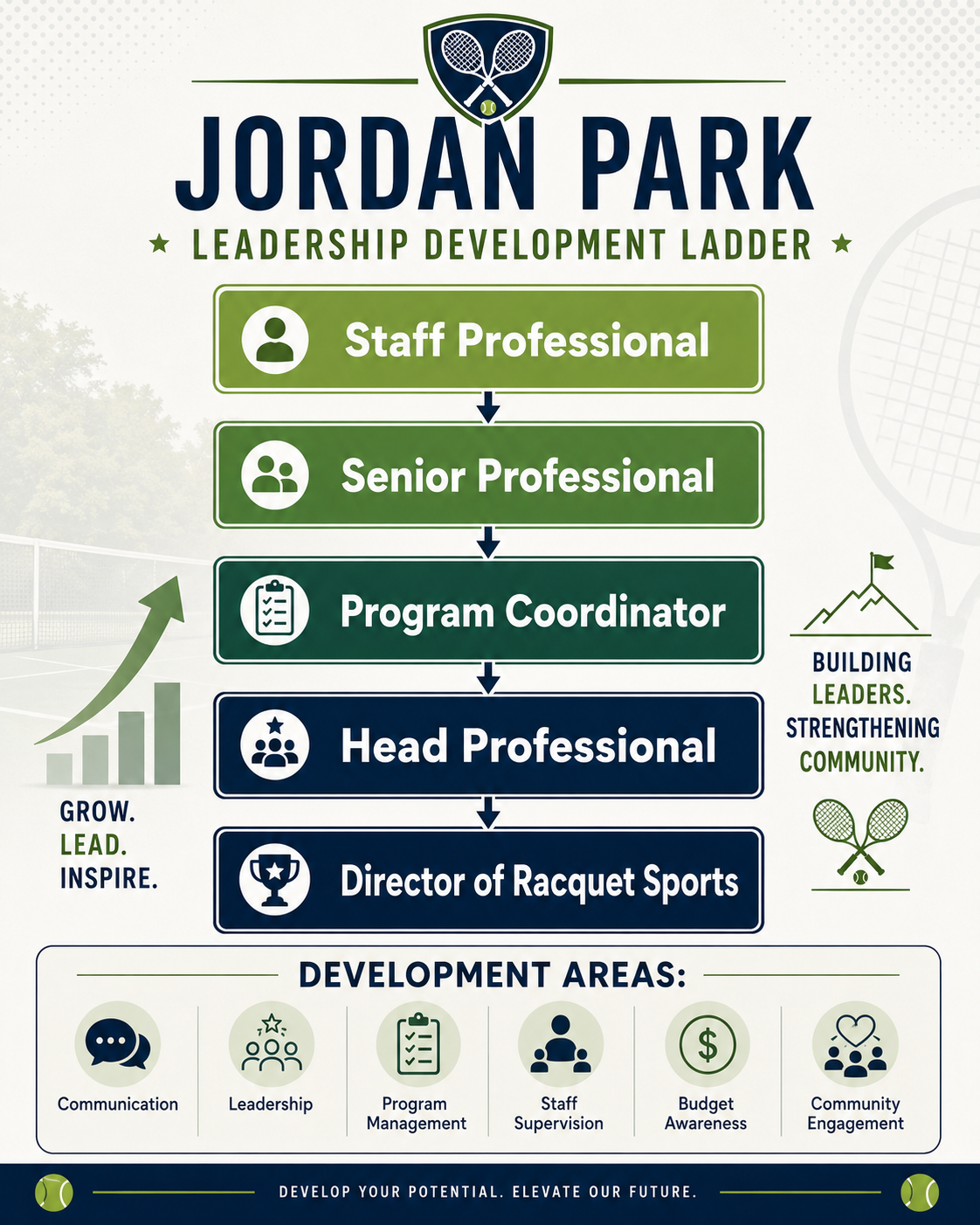
Staff readiness · onboarding checklistLeadership Development Ladder
Development steps toward greater coaching and leadership responsibility.
Career progression · development frameworkEmergency Action Plan
Emergency roles and response procedures for staff review.
Emergency response · proposed planFacility Rules & Regulations
Court-use expectations and participant conduct standards.
Participant conduct · proposed rulesHandbook, Procedures & Risk Register
Proposed Staff Handbook
Jordan Park academic operating model · September 2026
These proposed standards translate the Core 3 leadership and people-management plan into everyday expectations for coaches, program staff, and customer-service staff.
Roles & Readiness
The Director of Racquet Sports sets operating standards and reviews staffing, service, and performance. The program lead coordinates daily delivery and coach support. Each employee receives a role description, supervisor contact, schedule, and clear escalation route. Staff review their assignment before each shift and report absence or coverage concerns to their supervisor as soon as known.
Service & Inclusion
Welcome participants by name when possible, explain where to go and what happens next, and use age- and experience-appropriate language. Treat players, parents, colleagues, and community partners with respect. Help beginners understand equipment, court etiquette, and suitable program options. Refer accommodation and access requests to the program lead so they can be addressed consistently.
Communication & Records
Use approved facility channels for schedules, customer follow-up, and staff updates. Record attendance and program changes in RecTrac. Keep customer information and employee records accessible only to authorized staff. Follow current safeguarding rules for communications involving minors. Acknowledge professional inquiries within the portfolio’s 24-hour response target and identify the person responsible for follow-up.
Conduct & Safeguarding
Maintain a professional appearance, be prepared for the assigned program, and model calm, respectful conduct. Follow the facility rules, Emergency Action Plan, and current USTA Safe Play policy. Report safety or misconduct concerns through the appropriate reporting channels; supervisor notification does not replace required external reporting. Concerns should be raised without retaliation.
Development & Accountability
Complete the four-week onboarding pathway: orientation, observation, supervised delivery, and independent responsibilities after supervisor review. Use the 90-day review to agree on strengths, improvement needs, and development goals. Ongoing observation, customer feedback, and annual reviews guide coaching and advancement. Staff and supervisors document actions, owners, and follow-up dates. Handbook orientation and acknowledgment are recorded with onboarding materials.
Standard Operating Procedures & Safe Play
Purpose: Make service, safety, and accountability repeatable. The designated shift lead checks completion and resolves exceptions.
1. Opening & Court Readiness
Owner: Shift lead · When: Before opening and before program use.
- Review the schedule, staffing assignments, weather conditions, and outstanding issues from the previous shift.
- Inspect assigned courts, access routes, nets, teaching equipment, and the welcome area. Restrict use of hazards and notify the responsible lead.
- Confirm access to emergency contacts, the Emergency Action Plan, and designated emergency equipment.
- Prepare equipment and check-in materials; confirm registration and court assignments in RecTrac.
- Record readiness checks, unresolved issues, the responsible person, and the completion time.
2. Program Delivery & Participant Handoff
Owner: Assigned coach / program lead · When: Every session.
- Check attendance, introduce the coach, and explain the session plan and safety expectations.
- Match activities and equipment to participant age, ability, and goals; maintain the required supervision and safeguarding standards.
- Monitor court conditions and participant needs throughout the session. Pause activity and involve the lead when conditions require a change.
- Explain the next program step, record attendance and relevant coaching notes, and follow the approved release or pickup arrangements for minors.
3. Customer Concern & Service Recovery
Owner: Customer-service staff, with program-lead support · When: A concern is received.
- Listen, clarify the concern, and record the facts without promising an outcome outside the staff member’s authority.
- Resolve routine issues within approved policy; refer refunds, serious complaints, or recurring issues to the designated lead.
- Confirm the next action and follow-up timing with the customer.
- Record the owner, resolution, and any operating change needed to prevent recurrence.
4. Weather, Injury & Incident Response
Owner: Shift lead and staff assigned in the Emergency Action Plan · When: Unsafe conditions or an incident occur.
- Stop affected activity, protect participants from further exposure, and activate the relevant Emergency Action Plan procedure.
- Contact emergency services when required and notify the designated facility lead. Staff provide assistance within their training.
- Maintain appropriate supervision and use the approved communication and reunification procedures.
- Document the incident and actions taken. The authorized lead determines when affected activity can resume and reviews corrective action.
5. Closing & Shift Handover
Owner: Closing lead · When: End of operations.
- Confirm programs have ended and participant departures are accounted for under the facility’s procedures.
- Store equipment, inspect the work areas, and secure designated spaces.
- Reconcile attendance and registration exceptions; record maintenance needs and unresolved customer issues.
- Send the next shift a concise handover with priorities, owners, and follow-up dates.
Safe Play Compliance Check
Before relevant assignments, the Director verifies each applicable staff member’s current Safe Play approval and records renewal dates. USTA SafeSport training and policy acknowledgment are annual requirements; background screening is required every two years. Current USTA requirements govern scope, timing, appropriate interactions, and reporting. Staff review them during onboarding and when policies change.
USTA Safe Play policy and reporting requirements · USTA renewal guidance
Organizational Threats & Response Register
Proposed review rhythm: Review open risks at weekly staff meetings and assess trends with the monthly KPI dashboard. Each issue has an owner, response, due date, and documented follow-up.
- Staffing gaps or turnover. Warning signs: uncovered shifts, repeated absences, or declining coach retention. Owner: Director. Maintain a coverage plan, review workload, cross-train staff, and use development and retention conversations to address causes.
- Inconsistent coaching or customer experience. Warning signs: repeated complaints, weak observation feedback, or satisfaction below the 90% target. Owner: Program lead. Observe delivery, agree on a coaching action plan, and recheck participant feedback.
- Safety or safeguarding lapse. Warning signs: expired approval, unresolved hazards, or an incident report. Owner: Director / shift lead. Pause affected duties or activity, activate the appropriate procedure and reporting route, and verify corrective action before resuming.
- Low enrollment or weak retention. Warning signs: fill rate below 75% or customer retention below 70%. Owner: Program lead. Review schedule, placement, pricing, and participant feedback; test targeted outreach and assess the next enrollment cycle.
- Budget pressure. Warning signs: unfavorable revenue or labor variance and programs missing their contribution goals. Owner: Director. Review assumptions and enrollment with program leads, adjust controllable costs or schedules, and document the effect on community access.
- Communication or system disruption. Warning signs: missed messages, duplicate bookings, or a registration outage. Owner: Shift lead. Use an approved temporary attendance and communication process, protect personal information, and reconcile records when service returns.
Action log fields: Issue · Date identified · Impact · Responsible lead · Corrective action · Due date · Status · Follow-up result.